

TLDR: In the AI era, while AI acts as the content generator, technical professionals must act as the editor using IQ to ensure quality and EQ to maintain human connection. True engineering leadership requires a balance of EQ, IQ, and AI, as emotional intelligence is crucial for preventing dependency on AI tools and fostering team independence. Based on my post from 2025 about How to Develop EQ as an Engineer or a Manager. To celebrate WonderLead’s 2nd birthday, get your discount for workshop and cohort where practicing EQ, self regulation, AI, and leadership.
Hi! A year ago I wrote about my learning of the importance of EQ at the workplace.
It was so important in my career that I became an EQ Champion at AWS.
The post was published as Paid article in Gregot Ojstersek’s newsletter and it became the most liked and read post I ever wrote (121❤️). Back then, AI wasn’t almost writing our code neither drafted our presentations. Today it does, so I’m rewritting it for the AI era, as a gift to WonderLead subscribers, to celebrate WonderLead’s 2nd birthday!
At the bottom you will find also the new workshop and cohort coming for practicing the skills.
What You’ll Learn
💡 Why “high IQ, low EQ” can risk your career
💡 IQ vs EQ, redefined for a world where AI seems to be more intelligent than you
💡 How to develop Emotional Intelligence
💡 How Nervous System Regulation and EQ improve your leadership skills
Why “high IQ, low EQ” can risk your career
When early in my career I got feedback that I had a high IQ but low EQ, I got confused. I always believed emotions had no place in the workplace.
Then, I listened to The Power of Vulnerability by Brené Brown and read Emotional Intelligence by Daniel Goleman, and found out I was doing things wrong. Embracing our emotions is a powerful leadership tool. Suppressing them was stopping my growth and, at the Staff level, it was risking my job.
I wasn’t aware. Stopping my emotions was quietly hurting the team’s well-being and the efficiency of our collaboration and communication.
Learning about Emotional Intelligence (EI) and how to embrace it allowed me understand myself and connect better with others. It unblocked my path toward the person I wanted to be: a role model for my team, a leader who inspires.
And I believe I achieved my dream without climbing the professional ladder. As a Staff Engineer without formal authority, I’ve influenced executive leaders (AWS Senior Principals and Directors) and the vision across organizations through inspiration and curiousity.
My learning then: Being good at interacting with people isn’t just for managers. EI makes us more human, and it’s the multiplier that transforms good engineers into exceptional technical leaders.
My learning now, a year later into the AI era: Being good at interacting with people is the part AI can’t do for you. Many things are being automated. Still the best achievements are done through genuine connection. Therefor, genuine connection has become the competitive advantage. In fact, neuroscience proves that real conversations release oxytocin, which builds the trust needed to close complex issues.
IQ vs EQ: Which One Do I Need as a Tech Lead?
IQ (intelligence quotient) measures cognitive intelligence: The capacity for problem-solving, critical thinking, and logical reasoning about what is known.
EQ (emotional quotient) measures emotional intelligence (EI): The ability to understand and manage our own and others’ emotions, and to use that awareness to guide our decisions.
Before, when a colleague asked me for help, I immediately jumped to solutions, and sometimes I offered myself to fix things. It felt good to help. Then, it got to a point where I became a bottleneck unintentionally.
|–> I was showcasing a high IQ, but low EQ.
After learning EQ, I listen, ask questions, and support my team to get through the challenges. Then, if my team really needs my answers, I walk through my reasoning together with my peers, turning solutions into learning opportunities.
|–> I showcase my EI first. And it feels great too. I help my peers to grow and scale.
Today, AI is performing the IQ side of the job faster than any of us expected. The core components IQ tests measure (technical knowledge, memory, pattern recognition, and problem-solving) are precisely what a model can now do in seconds, with increasing accuracy. And the pull to “just fix it” that made me a bottleneck is stronger than ever. Because now we and our team members can generate the fix in seconds using AI. But the risk is the same it was before. Accepting a solution without understanding and becoming dependent on an outside source.
Now, it is critical to learn how to lead our teams and ourselves. Even when interacting with AI, we must practice active listening, ask questions, and dive deep into challenges without losing our own judgment.
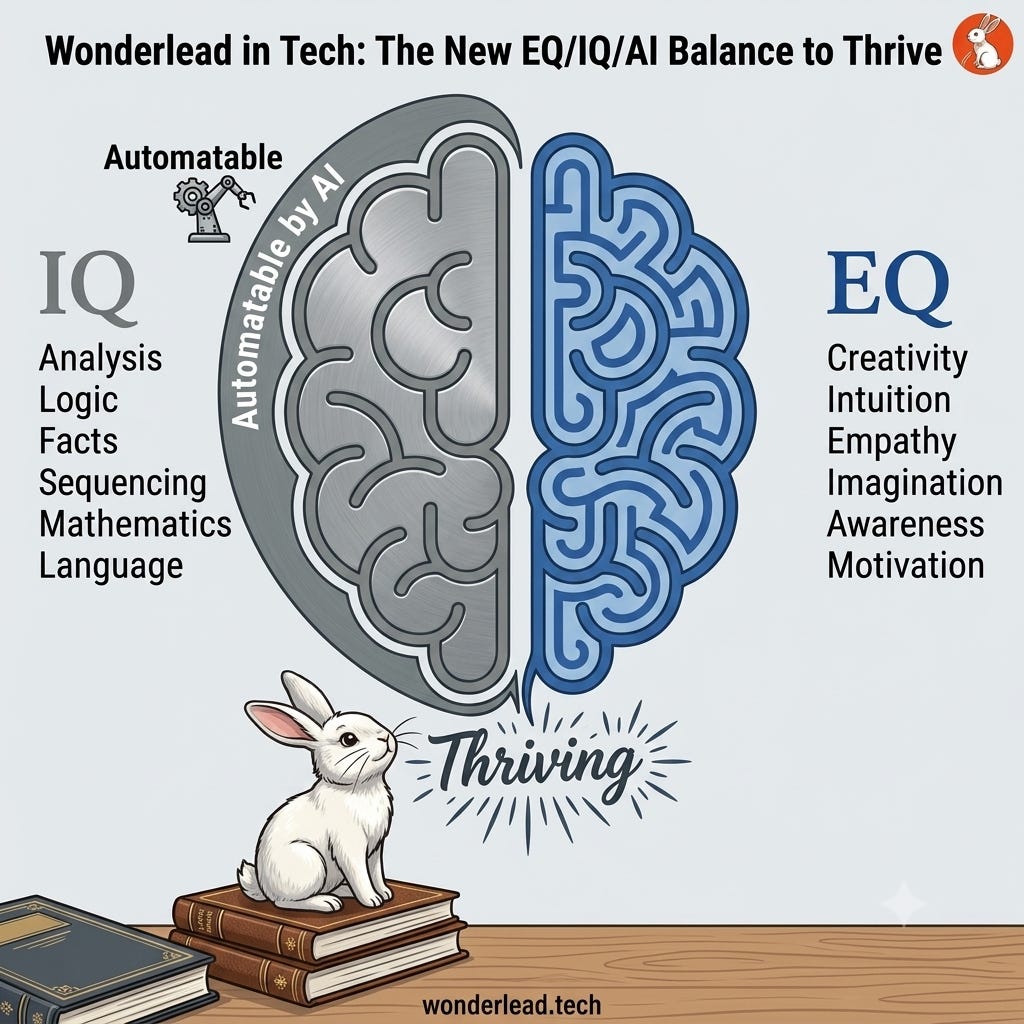
By combining EQ and IQ and AI, we achieve greater success.
Both types of intelligence influence our job performance, quality, relationships, and overall well-being. It’s not that I didn’t have EQ, it was that my EQ and IQ were not balanced. Understanding and developing both is still the key to thrive. What changed is how we use them.
In an AI-driven world, your EQ keeps your team independent and growing, while your IQ gives you the critical thinking needed to filter out the "AI slop" and to find true quality. AI is the generator which can have mistakes. IQ is the editor that makes safe, scalable, and correct the AI generations.
Choose the EQ/IQ/AI areas you need to improve by considering:
Self-assessment results: Stanford-Binet for IQ; MSCEIT, STEM, or ESCI for EQ.
AI’s impact on your daily job: Choose the models and harnesses that work best for your use cases at your job with WonderLead AI Builder Stack.
Your current job requirements, your passion, and future career aspirations: EQ becomes more valuable at higher leadership levels while AI and IQ at lower levels.
The Secret of Top-Performing Teams Is Not AI but EQ
According to Daniel Goleman, emotional intelligence matters twice as much as IQ or technical expertise in determining performance. He says it’s almost 90 percent of what sets star leaders apart. Multiple studies support this, and 20% of companies measured EQ in 2024.
“Strong emotionally intelligent leaders tend to lead more successful teams.” - Joshua Freedman
“Companies with more self-aware employees, from IC to top-level executives, significantly outperform while only 10% of people are actually self-aware.” - Korn Ferry Institute
In my personal experience: Emotional intelligence was a growth area that was recommended by my manager. After starting to apply it, the team’s and my performance increased.
In a research I conducted last May, I learned that 96% of engineers said they don’t trust AI’s output, but only about half actually verified it (source). That gap between what we know and what we do is an EQ problem and where most AI quality failures originate.
“We need to bring the same self-awareness and self-regulation when working with AI. The human in the loop actions can’t be fixed by an AI tool.” - Patricia Juarez
How Do I Develop Emotional Intelligence in the AI Era?
The way I personally learned about EQ was by listening to podcasts and reading books. Then I took notes in my second brain, an Obsidian vault. Writing it down is how I retain the information better.
Here’s my recommendation for you on how to start in this AI era:
1. Dive Deep into Daniel Goleman’s Emotional Intelligence Model
Goleman’s website describes the EI model’s 4 domains: Self-Awareness, Self-Management, Social Awareness, and Relationship Management. And breaks it down into 12 competencies defined from the common traits of the highest performers across dozens of organizations.
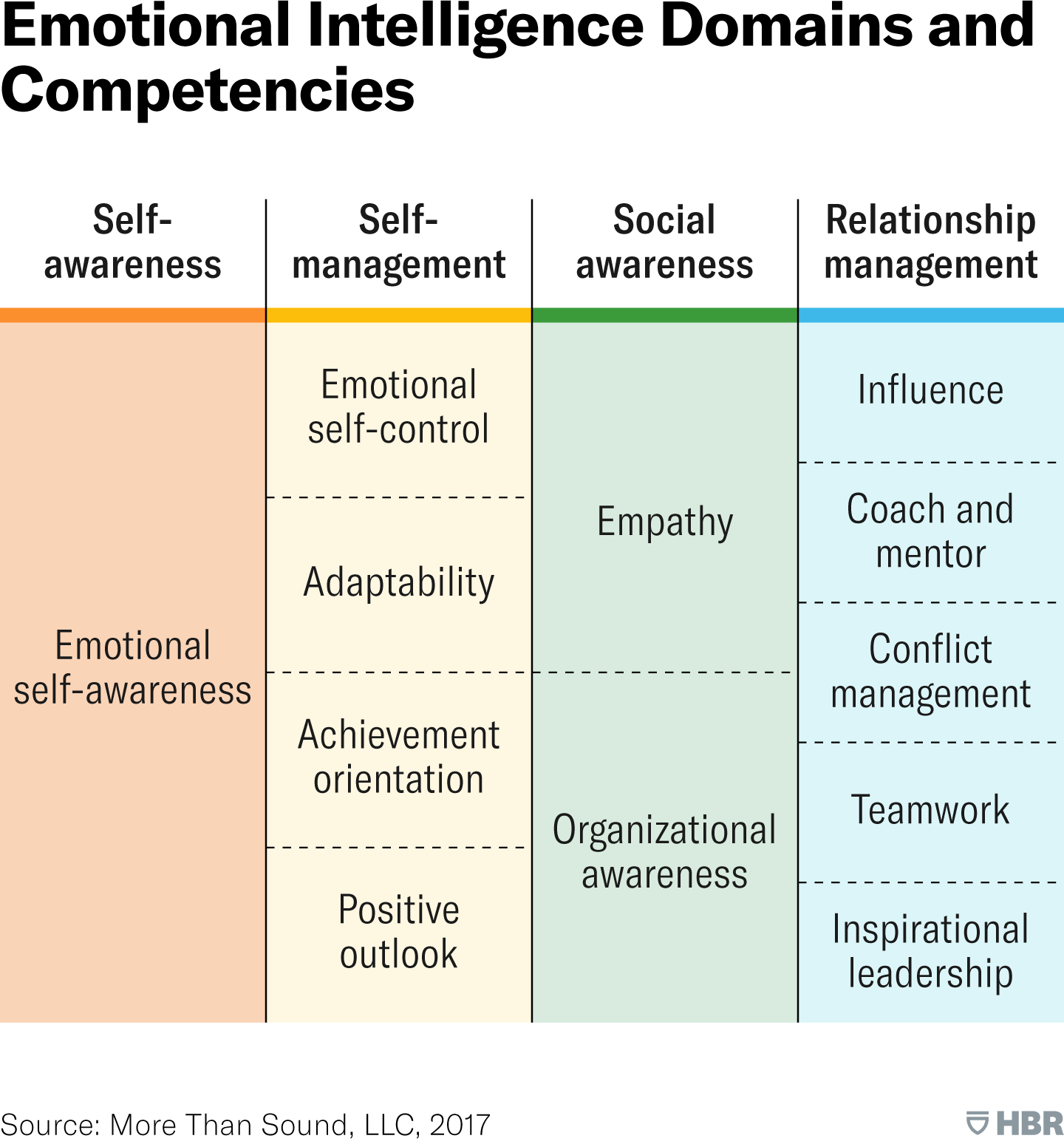
2. Master Goleman’s 5 Key EI Competency Sets
These are the five sets of skills that determine who is hired and who is fired in the top corporations, according to Goleman. Finding balance across all of them and proficiency with AI is what will allow you to excel!
1. Self-Awareness
Ability to understand our emotions and their impact on our experiences, through self-reflection. Identifying how well we’re really doing, and making intentional choices based on our values or purpose.
Why: Foundation of intentional leadership. Less assumptions and biases, and more understanding between peers and how the organization works.
Example: I started managing myself and aligning better with my peers.
🌟 Tips: Journaling to identify how you feel, your triggers, your biases, and assumptions. Feedback, mindfulness, gratitude, and self-compassion all increase self-awareness and presence. You can practice daily with WonderLead RePLAN, just ask for private beta access.
🤖 In the AI-era: Notice when you’re outsourcing a feeling, not just a task. It will allow you to identify the right tasks you must do and save time and tokens.
2. Self-Regulation
Ability to keep disruptive emotions and impulses in check.
Why: Easier to stay calm and effective under stress, crisis, or triggered moments identified with self-awareness.
Example: I used to get very nervous when talking with executives. Now I notice the feeling, acknowledge them, and I talk with pause and calmness.
🌟 Tips: Sleep well and do exercise to avoid being reactive. Pause when an emotion is triggered. And breathe and prepare before important meetings.
🤖 In the AI-era: Notice the flash of irritation when AI gets something wrong after you trusted it. That reaction is data about your expectations, not the tool. Slow down and reconsider the prompt and model. There are times another prompt will not help.
3. Motivation
Involves setting clear goals and pushing toward achieving them. Having positive attitude and forward drive.
Why: Drives change and inspires others.
Example: I am known for my optimism. In my opinion, if we don’t believe that we can achieve the change that our customers need, we won’t act, nor move the needle. I’m an advocate of our vision!
🌟 Tips: Align your actions with the vision and customer needs. Learn how change happens in your company. Even in large corporations, our voice can be heard regardless on the level and role.
🤖 In the AI-era: AI can draft the plan. It doesn’t know about your emotional state nor can supply the conviction that makes a team actually move on it. With RePLAN you bring the emotional awareness to your AI agents. DM me for private beta access.
4. Empathy
Ability to sense others’ feelings and seek their perspectives. Take an active interest in their concerns and identify how best to collaborate with them through attentive listening.
Why: Deeper engagement improves collaboration and retention, because the team feels appreciated.
Example: I used to stay quiet if the other person got silent, and sometimes unresolved issues impacted the team. Now I am extra curious and kind. I start with vulnerability and follow with compassion. Then I try to understand my peers’ struggles, offer my help, and act.
🌟 Tips: Stop thinking in solutions. Listen and ask questions to help the other person share what they actually need. When working remotely, if you sense something might be wrong, don’t leave it as it is, go and ask for a 1:1 call!
🤖 In the AI-era: Don’t let a model assume what a person might feel and miss a 1:1 or review. Reading the room is not something you should delegate.
5. Social Skills
Daily interpersonal skills, such as collaboration, cooperation, conflict management, influence on others, and handling change.
Why: Strong relationships lead to effective solutions and leadership.
Example: I used to be the first one to talk, or hard to reach when busy. Applying empathy and self-awareness to my social skills changed my leadership style.
🌟 Tips: Read leadership books and do trainings to improve communication and collaboration. As builders, social skills help us reach better solutions, faster.
🤖 In the AI-era: The teams succeeding with AI are the ones who can disagree productively about what the AI produced or the systems to consume it better. The best tool or prompt doesn’t scale to the team without social skills.
3. Join a Community and Practice Intentionally, With Balance
Use self-assessments to identify the competencies you need most. Then practice that competency regularly, with a community. A community holds you accountable, shares its own learnings, and supports your growth.
4. Transform Your Team’s Emotional Intelligence
Share this post and this anniversary events with your team.
Make Emotional Intelligence part of your company’s values. A feedback culture increases psychological safety and creativity.
Invest in your team’s growth by hosting EQ team discussions or hiring training sessions. The same events happening can be brought to your team. DM me.
🦸🏻♀️🦸🏻♂️ Transforming your team with EQ will improve teamwork, conflict management, job performance, and satisfaction. And in the AI era more than ever, because EQ is the one thing nobody can automate for you.
This Month: WonderLead Turns 2 🎉
Two years ago I hit publish with the conviction that we shouldn’t navigate our careers alone. Since then it’s grown into 450+ of you, and into something bigger than a newsletter. Products, community, workshops, and a whole cohort program built on the same idea, now applied to the AI transition too.

To celebrate, the WonderLead Anniversary a mix of Berlin and online events will happen in the follow weeks. Join the one you feel the most! I will love to meet you:
🇩🇪 Your Human Edge in the AI Era (IRL Berlin): An in-person workshop to learn and practice self regulation and EQ to become better leaders. On July 29 at 17:00 CET in w3hub.group.
💻 Your Human Edge in the AI Era (online): The same workshop but online. Waitlist open here. [Date TBD]
🐇A free accountability call, open to everyone, wherever you are. Where we share what didn’t work, what worked, and what we need next. On August 8th, 6pm CET.
🤖 AI WonderLead Practitioner Residency cohort 2 will start on August 10th! A 12-week cross-functional cohort, where you practice exactly this EQ/IQ/AI leadership balance on a real AI-Native team, under real pressure, while delivering a real product, instead of just reading about it with my direct coaching.
If you want to join the team or want to learn more, DM me.🎁 All week: readers get 20% off by using the code WONDER2.
If any of this is interesting, reply to this email or send me a DM. And if you’re new here, subscribe so you don’t miss the rest of the anniversary coming posts.
Tasks for Your EQ Week
☑️ Pick one EQ competency above and name where you’re weakest, honestly.
☑️ Notice one moment this week you reached for AI (or for the “just let me fix it” instinct) instead of actively listening yourself or team. Write down what you’d do differently.
☑️ RSVP to the Berlin meetup or the online call. Reply “Berlin” or “Online” and I’ll send you the details as soon as they’re locked.
☑️ Share this post with one person whose high-IQ and high-output are quietly burning out their team without meaning to. It might be the post that changes their leadership way, the way it did for me.
P.S. If you were here a year ago and remember the original IQ vs EQ post, thank you for supporting WonderLead in Tech. This rewrite exists because of you. And special thanks to Gregor Ojstersek who trusted me to write my first guest post in Substack.
We’re in this AI shift together.
AI speed can be overwhelming. The FOMO and anxiety due to the noise is real.
Use WonderLead community and tools to reduce it and focus in what matters most.
If you enjoyed this post, please tap the Like button below ♥️ Thank you!
This post opinions are my own, and may not reflect the opinions of the company I work for.